Background
Pratyabhijñā — recognition as the engine of creativity
The Pratyabhijñā school of Kashmir Śaivism (10th–11th c.), brought to canonical form in Abhinavagupta's Īśvarapratyabhijñāvimarśinī, treats creative cognition as a recognition (pratyabhijñā) event, not a generation event. The classical sequence — cit (luminous awareness), ānanda (impulse), icchā (volition), jñāna (selection), kriyā (rendering), and the reflexive vimarśa that closes the loop — forms what later commentators call the five-śakti cascade. PCE adopts this sequence as engineering vocabulary, not metaphor: each operator has a typed contract, an audit log, and a falsifiable behavioural prediction.
The choice is unusually well-fitted to the mechanism question we want to ask. Vimarśa is precisely the operation of reading one's own surface and deciding whether revision is warranted; that is the H8a/H8b mechanism. Apohana — exclusion of competing alternatives — is precisely what an icchā stage that operates as best-of-K with negation does; that is the ADR-001 substrate. The vocabulary discharges obligations rather than decorating them.
Active inference and Bayesian Model Reduction
Active inference, in the Friston lineage, casts perception and action as the minimisation of variational free energy. The framework supplies us with two specific primitives that v0.4 uses: a free-energy budget that gates whether the recursive revision pass fires (ADR-003), and a Bayesian Model Reduction step that prunes generative-model components when they no longer earn their complexity cost. We do not claim full variational descent during inference — the OAuth Claude CLI does not expose the sampler, so the cascade approximates Bayesian inversion through prompt-level best-of-K with composite scoring. The paper's §4 is explicit about this constraint.
The variational identity that holds the framework together is F = E_q[log q(z) − log p(z, o)] = D_KL(q(z) || p(z|o)) − log p(o): a generative surface o is "good" exactly when the cascade's approximate posterior q(z) over latent candidate continuations is close to the true posterior p(z|o), with low residual surprise over o itself. Creative cognition is naturally cast as F-minimisation when the surface — a quatrain, an interpretation, an alternative use — is what gets inferred. Each PCE operator is one discrete bookkeeping step inside that F-minimisation: cit seeds the candidate posterior, icchā reduces KL via best-of-K with composite scoring, vimarśa performs a second-pass revision that lowers expected surprise on the committed surface.
Bayesian Model Reduction is the operator that prunes posterior components which no longer earn their complexity cost — formally, drops a candidate z_i when its evidence ratio p(o|z_i) / Σ_j p(o|z_j) falls below a threshold scaled by the prior complexity penalty. The cascade's apohana (negation / exclusion) stage is BMR realised at the prompt level: candidates that share too much surface with the bare reference, or duplicate other candidates, are dropped before jñāna selects. ADR-003's free-energy budget is the meta-gate over the same machinery: it tracks the marginal F-reduction across the cascade and stops vimarśa from firing another revision once that marginal reduction falls below threshold. Together, BMR-as-apohana and the F-budget make the recursive revision pass principled rather than open-ended — the cascade has a stopping criterion grounded in the same variational bookkeeping that motivates the architecture in the first place.
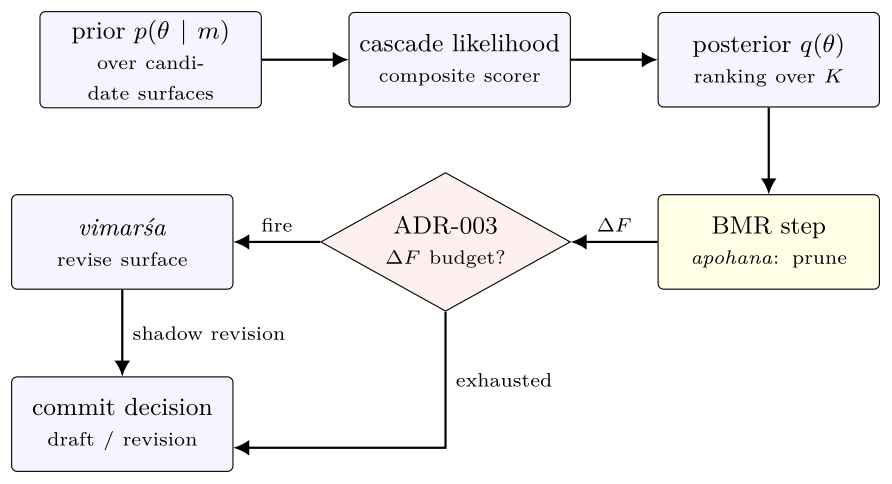
Why this matters for creative cognition: pratyabhijñā is precisely the moment of F-minimisation when the right candidate is identified — the moment when the posterior collapses onto a surface that the cascade recognises as the right one, rather than generating one from scratch. The same F-minimisation story explains why vimarśa's revision pass measurably improves the surface (H8a) and why a learned commit gate beats the v0.3 event gate (H8b): both findings are about getting closer to argmin F. The architecture page walks the F-minimisation interpretation operator-by-operator under "What 'computation' looks like in this cascade", and the results page shows the empirical signatures.
What the substrate is
PCE has a single supported substrate: claude --print over the OAuth-bound Claude CLI. The Anthropic Python SDK code path was removed in Phase 8 (see ADR-007 on the plugin page). For the Phase 7 mechanism pilot, the same CLI was pointed at the managed Anthropic-API substrate (parallel API calls under a quota envelope distinct from the OAuth substrate) so the experiment could parallelise across domains; this is documented as a deliberate substrate-deviation event in §7 of the paper. Day-to-day operation, including the showcase regeneration, runs against the OAuth substrate.
Companion work
PCE is the second project in an author program that grounds agent design in classical Indian darśana. The first, Pratyākṣa (direct perception / context-discipline), addresses hallucination resistance in long-context LLM agents and reports a strong positive Stouffer pooled signal across ten studies. PCE is the recognition+creativity counterpart and reports a smaller, more decomposed effect; the compounding work page contrasts the two empirical signatures honestly.